

A Complete Technical Guide to Choosing the Right Temporary Heater
When cold weather hits, maintaining a safe, productive environment on-site becomes essential. Whether you’re heating a construction site, warehouse, marquee, welfare cabin or temporary office, the type of heater you choose directly affects:
- Worker safety & compliance
- Comfort and productivity
- Energy efficiency & running costs
- Material drying times
- Equipment performance
- Project timelines
- Fuel usage & environmental footprint
At Ideal Heat Solutions, we supply one of the UK’s most comprehensive temporary heating fleets, including:
- 2kW–40kW Electric Fan Heaters
- 18kW & 72kW MDA Electric Heaters
- 47kW–375kW Indirect Diesel-Fired (IDF) Heaters
- Temporary boiler hire (for large-scale heating & hot water)
This expert guide explains the differences between electric fan heaters and IDF (indirect diesel-fired) heaters, with technical detail, example applications, pros and cons, and how to choose the right heater for your site.
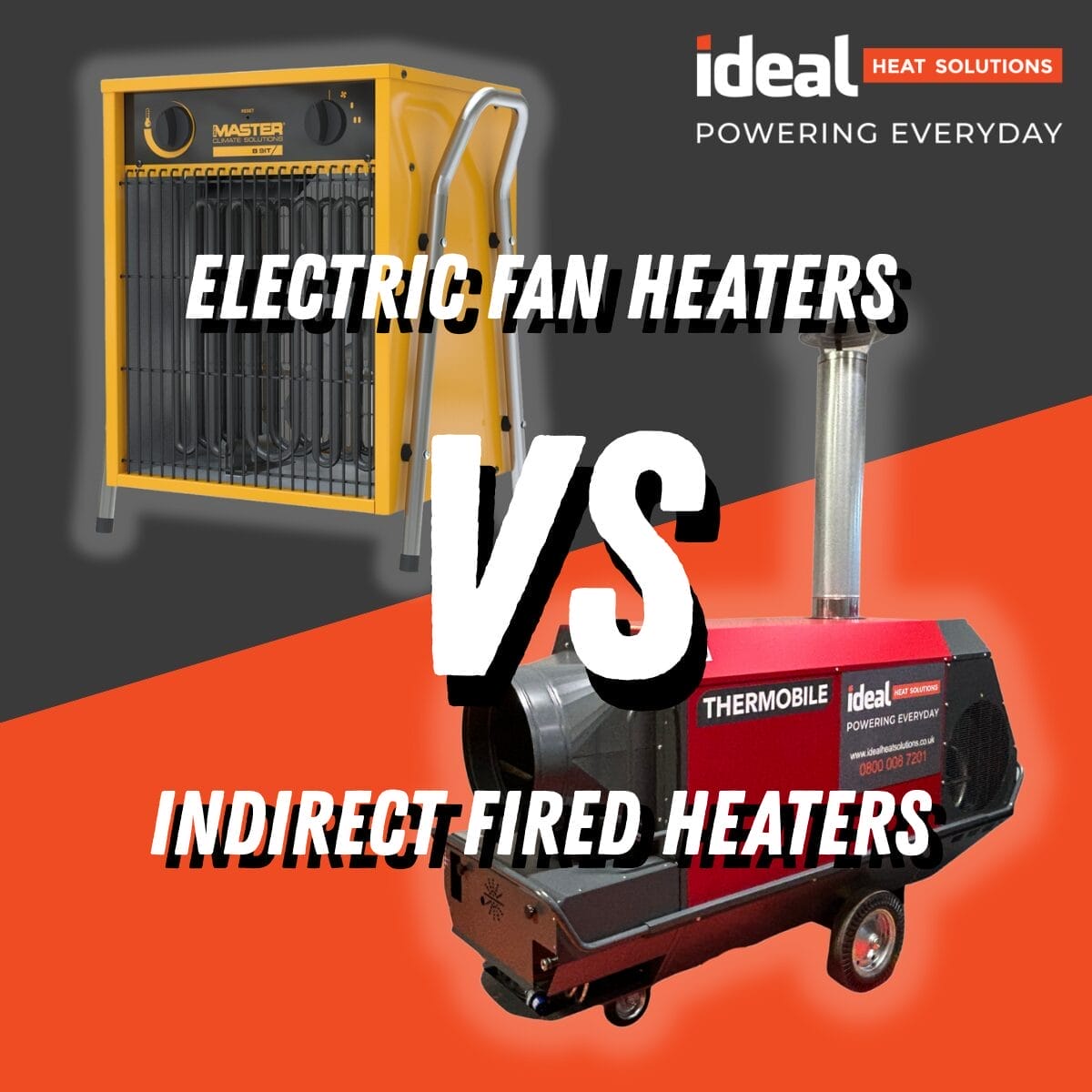
What Is an Electric Fan Heater?
Clean, Portable, Fume-Free Heat for Small to Medium Spaces
Electric fan heaters use electrical resistance elements combined with a high-speed fan to distribute warm air around a space. Because they use electricity rather than combustion, they produce zero fumes, making them safe for enclosed or occupied areas.
Electric heaters are used widely across:
- Welfare cabins
- Retail backrooms
- Site offices
- Temporary workspaces
- Domestic-style rooms
- Workshops
- Drying rooms
- Portable cabins
They are ideal when simple plug-and-play heating is required.
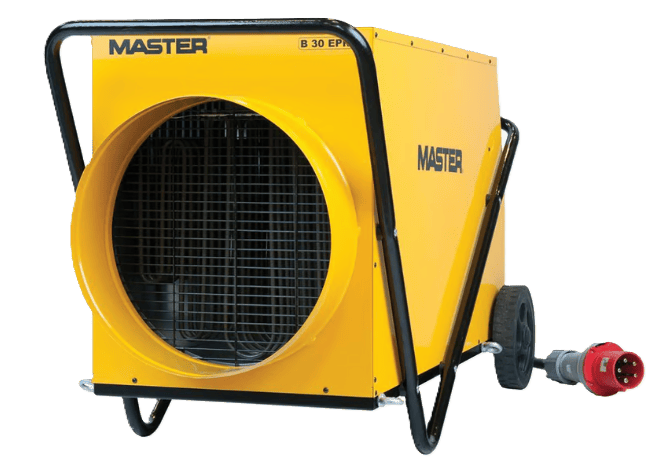
How Electric Fan Heaters Work (Technical Breakdown)
Electric fan heaters operate using:
- An internal heating element (usually stainless steel or ceramic).
- A built-in fan that pushes air across the heat source.
- A thermostat that regulates temperature automatically.
- Safety controls to prevent overheating or electrical overload.
The result is clean, instant heat with excellent mobility.
Ideal Heat Solutions Electric Fan Heaters – Technical Specifications
Below are the core technical specs from the units you provided.
IHS 2kW Electric Fan Heater (Small Portable Unit)
| Specification | Value |
|---|---|
| Heating Power | 1–2 kW |
| Airflow | 184 m³/h |
| Supply | 230V, 1ph |
| Current Draw | 8.7A |
| Temperature Range | 5–35°C |
| Thermostat | Yes |
| Dimensions | 220 × 200 × 330 mm |
| Weight | 3.7 kg |
Best For: small rooms, welfare units, offices, drying cupboards.
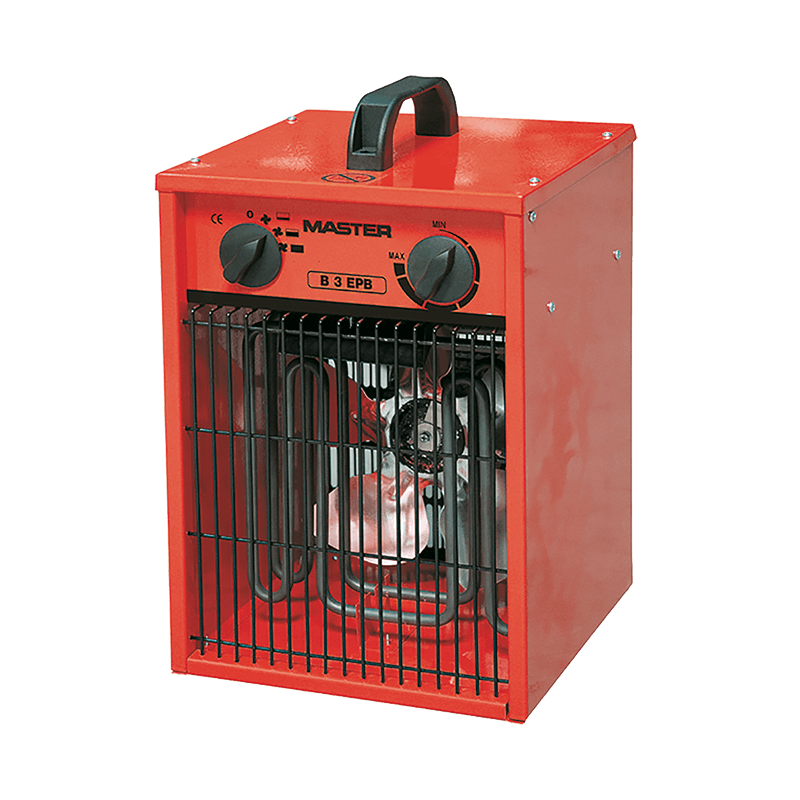
IHS 72kW MDA Electric Heater (Industrial High-Output Unit)
| Specification | Value |
|---|---|
| Heating Power | 36–72 kW |
| Airflow | 6,454–7,900 m³/h |
| Power Supply | 400V / 3ph |
| Current Draw | 110A |
| Plug Type | 125A / 5-pin |
| Thermostat | Onboard |
| Dimensions | up to 2250 × 740 × 1110 mm |
| Weight | 180 kg |
Best For: large industrial areas with 3-phase power, drying applications, high airflow heating.

Pros & Cons of Electric Heaters
✔ Advantages
- Zero fuel fumes / emissions
- Extremely safe for enclosed spaces
- Simple setup — plug-and-play
- Portable and lightweight
- Quiet operation
- Reliable for small to medium areas
- Thermostatic control prevents overheating
- Perfect for drying and warm-air circulation
✘ Limitations
- Heavily dependent on site electrical capacity
- Larger heaters require 3-phase power
- Running costs are higher per kW than diesel
- Not suitable for large warehouses or uninsulated buildings
What Is an IDF Heater?
High-Output, Fuel-Efficient Heating for Large Industrial Spaces
IDF heaters (Indirect Diesel-Fired heaters) generate heat by burning diesel or HVO inside a sealed chamber. Warm air is blown across a heat exchanger and into the building, while all exhaust gases are safely flued outside.
This means IDF heaters provide powerful, clean warm air suitable for areas where people are working — without introducing fumes.
They are designed to heat:
- Large warehouses
- Marquees & event structures
- Construction sites
- High-ceilinged industrial areas
- Large temporary buildings
- Agricultural facilities
- Industrial drying environments
- Concrete curing operations
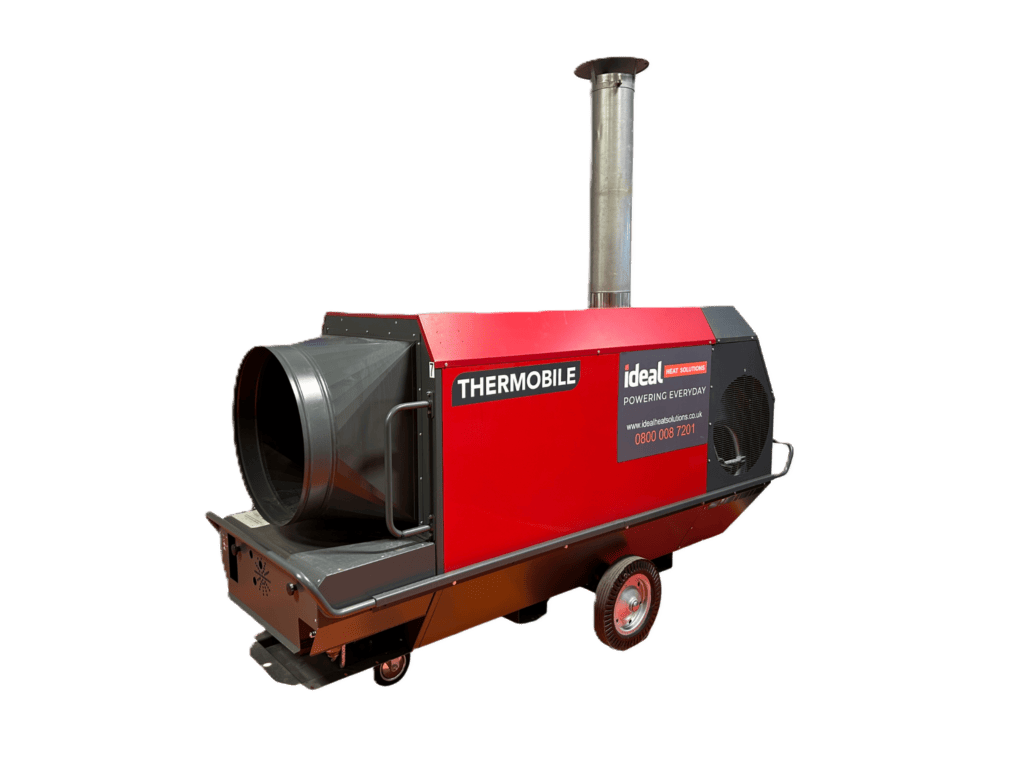
How IDF Heaters Work (Technical Breakdown)
- Diesel/HVO fuel is ignited inside a sealed combustion chamber.
- The chamber heats a high-efficiency heat exchanger.
- A powerful fan blows air over the exchanger.
- Warm, clean air is ducted inside the space.
- All exhaust gases exit via a flue to outdoors.
This ensures no fumes, moisture or CO₂ enter the workspace.
Ideal Heat Solutions IDF Heaters – Technical Specifications
IHS 47kW IDF Heater (Compact Industrial Unit)
| Specification | Value |
|---|---|
| Heating Output | 47 kW |
| Airflow | 1,800 m³/hr |
| Fuel Consumption | 4.7 L/hr |
| Power Use | 0.8 kW |
| Power Supply | 230V / 1ph |
| Thermostat | Analogue or Digital |
| Protection Rating | IP44 |
| Fuel Tank | 65L |
| Flue Diameter | 150 mm |
| Weight | 67–84 kg |
Best For: medium-sized workshops, marquees, construction drying.
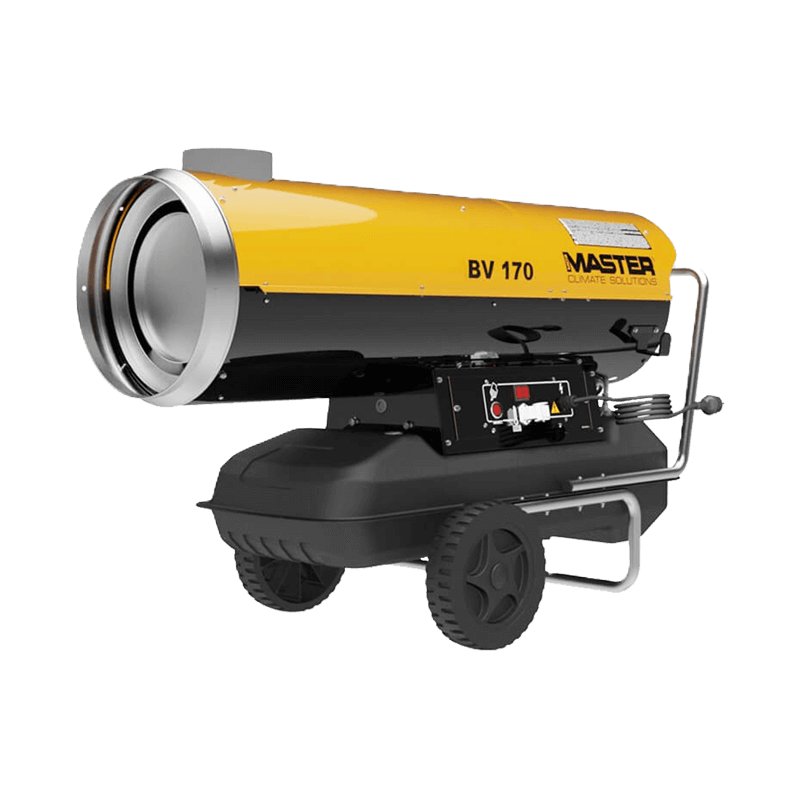
IHS 375kW IDF Heater (Large Industrial Unit)
| Specification | Value |
|---|---|
| Heating Output | 261–383 kW |
| Airflow | 18,000–24,000 m³/hr |
| Fuel Use | 26–38 L/hr |
| Power Use | up to 20.3 kW |
| Vent Pressure | 400–1,000–700 Pa |
| Outlet Diameter | 2 × 600 mm |
| Flue Diameter | 300 mm |
| Weight | 1,300 kg |
Best For: warehouses, large industrial zones, 24/7 heating, frost protection.

Pros & Cons of IDF Heaters
✔ Advantages
- Huge heat output (47–375kW)
- Excellent for large or open spaces
- Lower running costs per kW vs electric
- Warm air can be ducted 20–40m
- Clean, safe heated air
- Perfect for construction drying
- HVO-compatible for lower emissions
- Ideal for long-term or 24/7 industrial heating
✘ Limitations
- Must be located externally
- Needs diesel/HVO supply & monitoring
- Larger models need trained engineers
- Requires flueing & ducting
- Bigger footprint than electric heaters
Electric Heaters vs IDF Heaters – Technical Comparison
| Feature | Electric Fan / MDA Heaters | IDF Heaters |
|---|---|---|
| Heat Output | 2–72kW | 47–375kW |
| Fuel | Electricity | Diesel / HVO |
| Best For | Small–mid spaces | Large industrial areas |
| Air Quality | Zero emissions | Clean warm air |
| Installation | Indoors | Outdoors with ducting |
| Running Cost | Higher per kW | Lower per kW |
| Power Needs | 230–415V | Minimal electricity |
| Drying Use | Moderate | Excellent |
| Noise | Low | Medium |
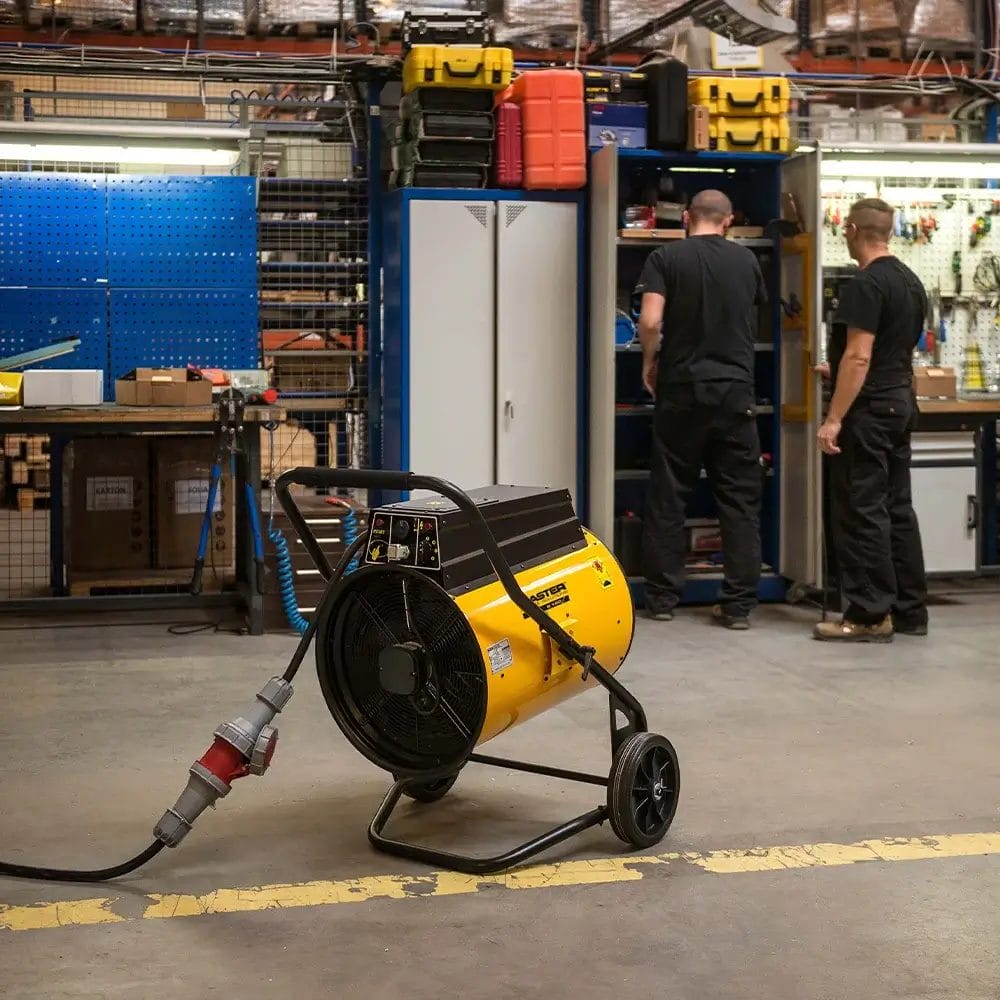
When to Choose an Electric Heater
Electric heating is best when you need:
- Safe heat for occupied spaces
- Portable, easy setup
- Heating <200 m²
- Reliable heat without fuel storage
- Fume-free, emission-free heat
- Low-noise heating
- Support for screed drying, paint finishing or warm-air circulation
Electric heaters are ideal for:
- Welfare cabins
- Site offices
- Retail rooms
- Workshops
- Temporary enclosed rooms
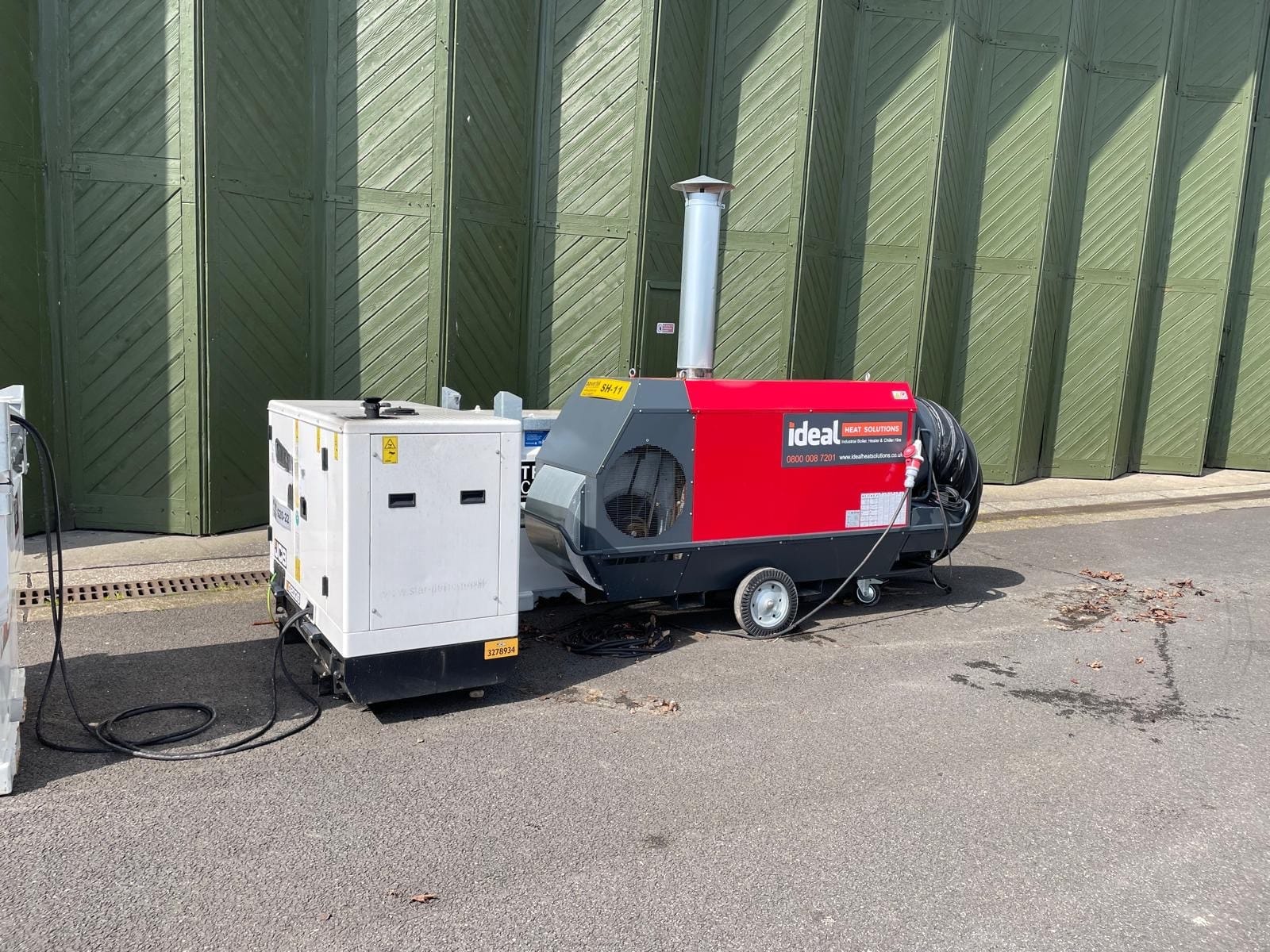
When to Choose an IDF Heater
IDF heaters are ideal when you need:
- High heat output
- Large-area heating (200–20,000m²)
- Long duct runs (20–40m)
- Frost protection or drying
- 24/7 industrial operation
- Fuel efficiency
- External installation
Perfect for:
- Warehouses
- Factories
- Marquees
- Temporary structures
- Construction drying
- Plant shutdowns / outages
How to Choose the Right Temporary Heater
Here’s the decision-making checklist:
1. Size & insulation
Small/insulated → Electric
Large/uninsulated → IDF
2. Air quality
Enclosed/occupied → Electric
Industrial with ducting → IDF
3. Power availability
Limited power → IDF
3-phase supply → MDA electric
4. Running cost
Short-term → Electric
Long-term → IDF
5. Drying requirements
Construction drying → IDF
Talk to Ideal Heat Solutions About Temporary Heating
We provide a full fleet of:
- Electric fan heaters (2–40kW)
- MDA electric heaters (18–72kW)
- IDF heaters (47–375kW)
- Temporary boiler hire (140kW–1.5MW)
- Fuel tanks, ducting, power cables, thermostats
- 24/7 nationwide engineer support
- Full heat-load calculations
To learn more or book a free site survey, contact Ideal Heat Solutions today.
📞 CALL US: 0808 3014 183
QUICK FORM FILL: Contact Us – Ideal Heat Solutions
Explore our latest project case studies
