

Specifying a temporary boiler for an industrial site is not the same as arranging heating for a commercial building. The load calculations are more complex, the consequences of under-specification are more severe, and the operational environment places greater demands on equipment reliability and safety.
Whether your site requires temporary steam, process hot water, space heating, or a combination, getting the specification right before equipment is deployed saves time, money, and operational disruption. This guide provides a practical framework for engineers, energy managers, and facilities professionals responsible for industrial boiler hire in the UK.
Understanding Industrial Heating Loads
Industrial heating applications typically fall into three categories:
Space Heating
Large warehouses, manufacturing halls, and logistics facilities require significant heat output to maintain safe working temperatures. The load is driven by building volume, insulation quality, ventilation rate, and the number of access doors or loading bays. For very large, poorly insulated industrial buildings, space heating loads can reach several megawatts.
Process Heating
Many industrial processes require water at specific temperatures, tank heating, product manufacturing, cleaning and sterilisation, chemical processes, and so on. Process loads are defined by the volume of water or fluid to be heated, the required temperature, and the rate at which heat is transferred to the process.
Combined Space and Process Loads
Many industrial sites have both space heating and process heating requirements, and these may operate simultaneously or on separate circuits. A comprehensive load calculation must account for both, with appropriate diversity factors applied.
Key Variables in Load Calculation
Building Heat Loss (Space Heating)
The fundamental calculation for space heating is based on the rate of heat loss from the building envelope. This considers wall, roof, and floor U-values, window areas and thermal performance, ventilation losses, and infiltration. For large industrial buildings with high ventilation requirements, infiltration and ventilation losses can dominate the calculation.
A simplified approach uses heat loss per unit volume. For a typical industrial building with moderate insulation, this is often in the range of 8–15W/m³. For a 10,000m³ warehouse, this gives a space heating load of approximately 80–150kW.
Process Load Calculation
Process loads are calculated from the formula: Q = m × Cp × ΔT, where Q is the heat load in kW, m is the mass flow rate in kg/s, Cp is the specific heat capacity of the fluid (4.18 kJ/kg·K for water), and ΔT is the temperature rise required.
For example, a tank heating application requiring 5,000 litres of water to be raised from 10°C to 80°C in two hours would require approximately: 5,000 × 4.18 × 70 / 7,200 = 203kW.
Diversification and Margin
It is rare for all loads on a large industrial site to operate simultaneously at full demand. A diversity factor, typically 0.6 to 0.8, is applied to the sum of individual loads to arrive at the design connected load. A contingency margin of 15–20% is then added to ensure the temporary boiler is not operating continuously at maximum output.
Common Industrial Boiler Hire Configurations
Based on the above, common configurations for industrial boiler hire in the UK include:
500–750kW packaged boiler for medium-sized process or combined space/process applications
1,120kW to 1,350kW packaged boiler for large process loads or multi-circuit industrial sites
Dual 500kW or dual 750kW configuration for resilience on critical process sites
1,500kW packaged plant room for the largest industrial applications or district heating connections
Fuel Considerations for Industrial Sites
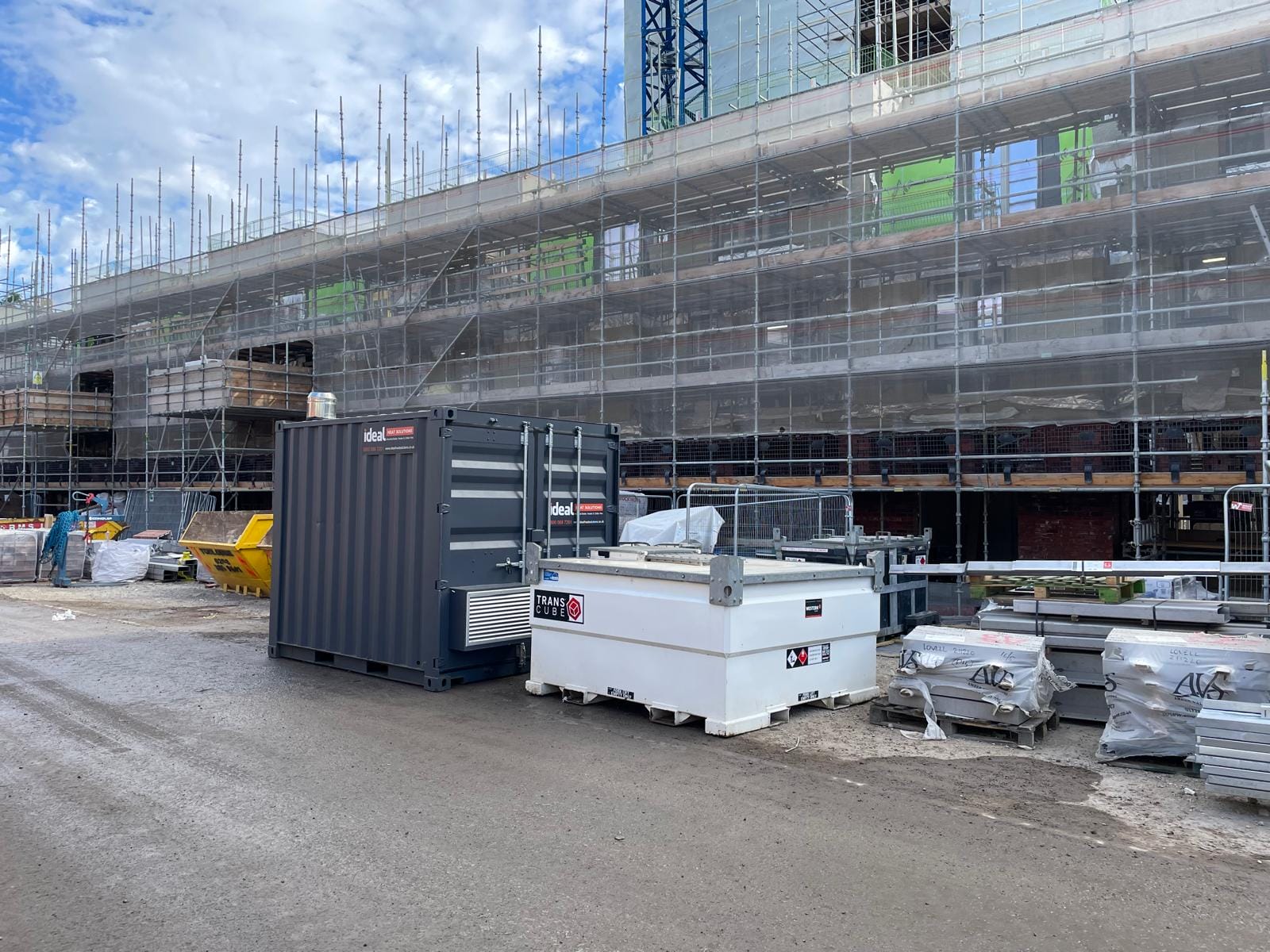
Industrial sites often have different fuel availability profiles compared to commercial buildings. Gas may not be available at the required pressure, or pipeline capacity may be insufficient for a large temporary load. Oil-fired boilers are therefore common for industrial temporary hire, offering fuel flexibility and the ability to store fuel on site.
Our fleet includes both gas and oil-fired industrial boilers. For oil-fired units, we supply bunded fuel tanks with telemetry monitoring and manage fuel deliveries to ensure continuity of supply.
Safety and Compliance for Industrial Temporary Boiler Hire
Industrial boiler installations are subject to the Pressure Systems Safety Regulations 2000, the Gas Safety (Installation and Use) Regulations, and relevant guidance from the Health and Safety Executive. All Ideal Heat Solutions installations are carried out by Gas Safe and OFTEC-registered engineers, with full documentation provided.
For process applications involving pressurised hot water, our team will carry out a written scheme of examination and ensure all pressure relief and safety systems are correctly configured and functional before handover.
Conclusion
Specifying the right industrial boiler for hire requires a clear understanding of the loads involved and the operational context of the site. Get it wrong, and you risk inadequate heating, excessive fuel consumption, or, in the worst case, safety issues.
Ideal Heat Solutions works with engineers and facilities professionals across the UK to provide properly specified, safely installed industrial boiler hire. Contact us on 01622 632 918 to discuss your requirements and arrange a technical assessment.