

Maintaining safe and comfortable temperatures within industrial and commercial environments becomes increasingly important during warmer months. Excessive heat can affect employee productivity, increase operational risks, damage sensitive equipment, and create uncomfortable conditions for workers and visitors.
Temporary cooling hire allows businesses to respond quickly to rising temperatures without investing in expensive permanent systems. Two of the most popular temporary cooling options are con coolers and evaporative coolers.
Although both systems help reduce temperatures, they operate differently and are suited to different types of environments.
Understanding the differences between air con cooler hire and evaporative cooler hire can help businesses choose the right cooling system for their site.
At Ideal Heat Solutions, we provide professional temporary cooling solutions across the UK for commercial, industrial, and event applications.
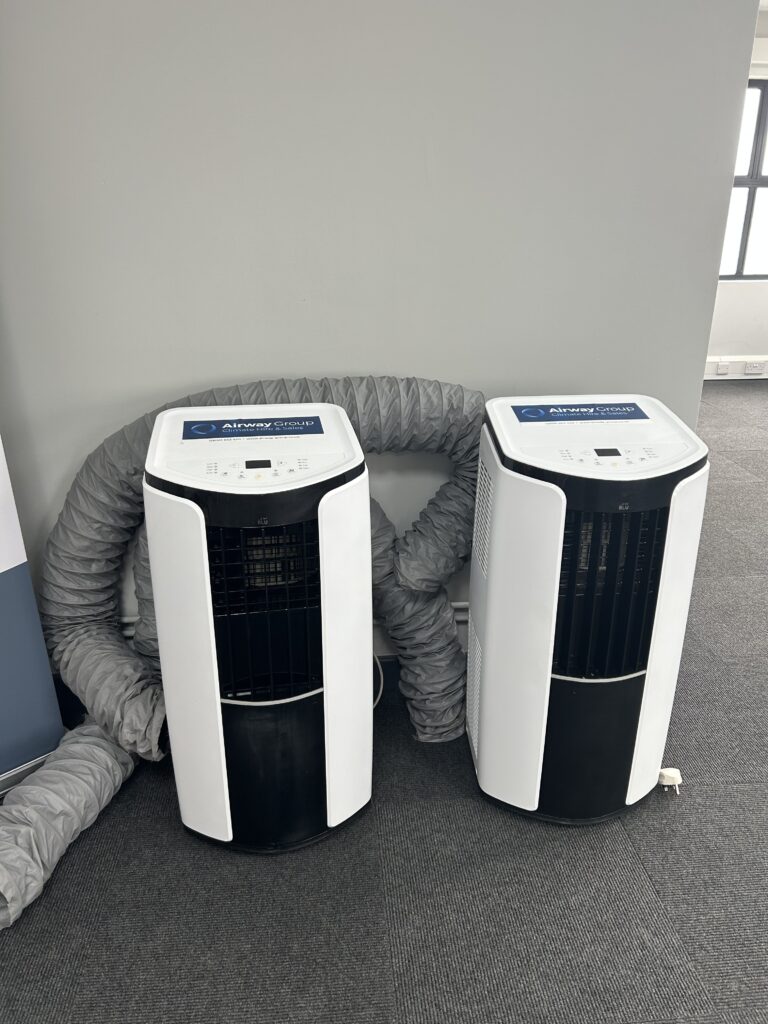
What Is an Air Con Cooler Unit?
An air con cooler is a portable industrial cooling system designed to provide powerful refrigeration-based cooling within enclosed or partially enclosed environments.
Air con coolers are commonly used within:
• Warehouses
• Manufacturing facilities
• Workshops
• Distribution centres
• Commercial buildings
• Temporary offices
• Industrial facilities
These systems provide strong cooling performance where stable temperature reduction is required.

What Is an Evaporative Cooler?
Evaporative coolers use water evaporation to cool the surrounding air.
Warm air passes through water-saturated cooling pads, where heat is absorbed before cooler air is circulated back into the environment.
Evaporative coolers work particularly well in spaces with natural airflow or ventilation.
They are commonly used for:
• Outdoor events
• Marquees
• Construction sites
• Warehouses
• Workshops
• Sporting venues
• Temporary hospitality areas

Key Differences Between Air Con Coolers and Evaporative Coolers
Cooling Technology
Air con coolers use refrigeration technology to actively reduce temperatures.
Evaporative coolers rely on natural evaporation to provide cooling.
This creates different performance levels depending on the environment.
Ventilation Requirements
Evaporative coolers perform best in ventilated spaces where fresh airflow is available.
Air con coolers are generally better suited for enclosed spaces where more controlled cooling is required.
Energy Consumption
Evaporative coolers usually consume less electricity than refrigeration-based cooling systems.
This can help reduce operating costs for temporary projects.
Moisture Levels
Evaporative cooling adds slight moisture to the air while air con coolers help maintain drier conditions.
Installation Requirements
Portable evaporative coolers are typically faster and easier to deploy.
Air con coolers may require additional positioning and airflow planning depending on the site layout.
Benefits of Air Con Unit Hire
Strong Cooling Performance
Air con coolers provide powerful cooling suitable for industrial environments experiencing significant heat loads.
Controlled Temperature Management
They are ideal for businesses requiring stable cooling conditions.
Suitable for Enclosed Spaces
Warehouses, offices, and production facilities often benefit from refrigeration-based cooling.
Reliable Industrial Cooling
Air con coolers are commonly used during:
• Equipment overheating
• Heatwaves
• Temporary breakdowns
• Production increases
• Building maintenance

Benefits of Evaporative Cooler Hire
Energy Efficient Operation
Evaporative coolers use significantly less electricity compared to traditional air conditioning systems.
Environmentally Friendly Cooling
These systems use water rather than refrigerants to cool the air.
Improved Airflow
Evaporative coolers help improve ventilation and circulation.
Rapid Deployment
Portable systems can be installed quickly with minimal disruption.

Which Cooling System Is Best for Your Site?
The best cooling system depends on several operational factors.
Site Size
Larger spaces may require multiple cooling units.
Ventilation Levels
Ventilated buildings are ideal for evaporative cooling.
Cooling Expectations
Businesses requiring stronger temperature reduction may prefer con coolers.
Budget Considerations
Evaporative coolers often provide a more cost-effective temporary cooling solution.
Occupancy Levels
Higher occupancy creates additional heat loads that may influence cooling requirements.
Common Applications for Temporary Cooling Hire
Warehouses and Distribution Centres
Cooling systems improve comfort and productivity for warehouse staff.
Factories and Manufacturing Facilities
Industrial cooling helps reduce heat generated by machinery and equipment.
Construction Sites
Portable cooling supports worker welfare during warmer weather.
Events and Hospitality Venues
Temporary cooling improves guest comfort during outdoor and indoor events.
Why Choose Ideal Heat Solutions?
Ideal Heat Solutions provides reliable temporary cooling systems for businesses across the UK.
Our services include:
• Air con unit hire
• Evaporative cooler hire
• Temporary cooling systems
• Industrial cooling solutions
• Emergency cooling support
• Nationwide delivery
• Flexible rental periods
Our experienced team works closely with clients to identify the most suitable cooling solution for each environment.
Conclusion
Both air con units and evaporative coolers provide effective temporary cooling solutions for commercial and industrial environments.
The right system depends on ventilation, cooling expectations, occupancy levels, and site conditions.
Whether supporting warehouses, factories, construction projects, or temporary events, cooling hire helps businesses maintain comfortable and productive working conditions.
Ideal Heat Solutions delivers dependable temporary cooling solutions designed to keep UK businesses operational throughout warmer periods.