

For many commercial heating projects, crane logistics become one of the most expensive and disruptive parts of the entire installation.
Traditional temporary boiler systems often rely on large packaged plant that must be craned into position due to their size and weight. While this approach can work in some environments, it creates significant problems for buildings with restricted access, busy urban locations, occupied premises, or structural limitations.
Today, many facilities managers and contractors are actively seeking alternatives.
This has driven rapid growth in modular boiler hire systems designed specifically to reduce or eliminate crane dependency.
At Ideal Heat Solutions, we regularly support temporary heating projects where modular boilers provide a faster, safer, and more cost-effective alternative to traditional crane-based installations.
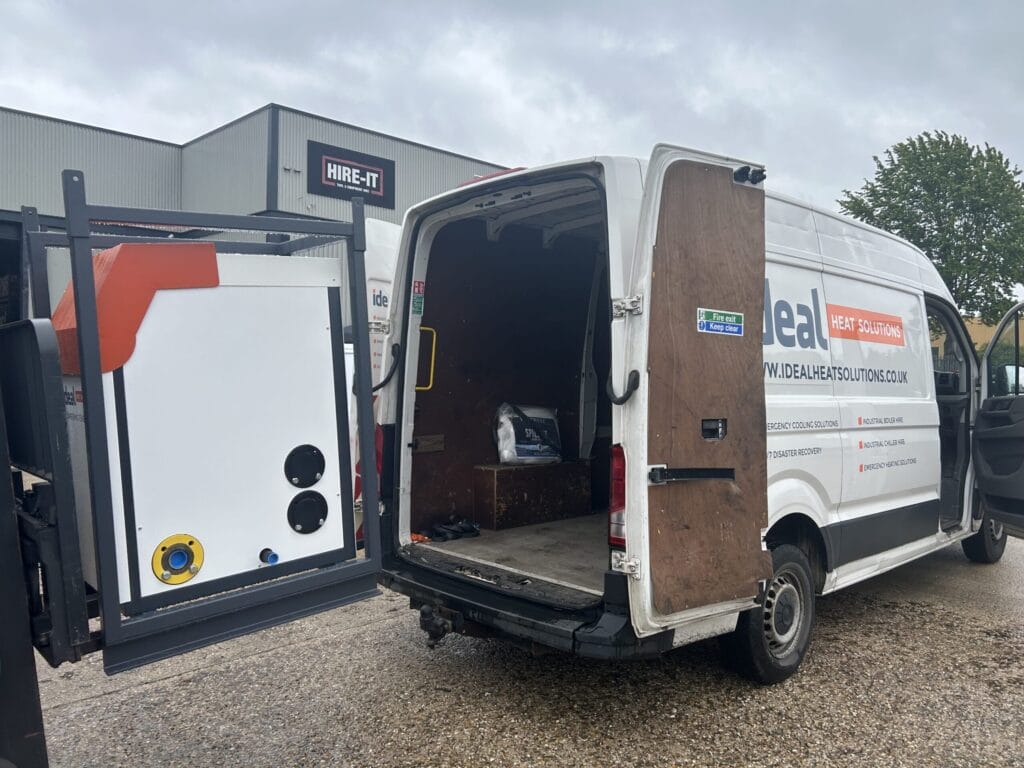
Why Crane-Based Boiler Installations Create Challenges
Large crane operations are complex.
Before a temporary boiler can even arrive on site, projects may require:
- Road closures
- Traffic management
- Lift plans
- Structural assessments
- Local authority permissions
- Specialist lifting contractors
- Out-of-hours working
- Extended project coordination
In busy city-centre environments, this can dramatically increase both cost and project duration.
For emergency boiler failures, delays caused by crane logistics can also create serious operational consequences.
The Hidden Costs of Crane Operations
Many organisations underestimate the true cost of crane-based temporary boiler installations.
Costs may include:
- Mobile crane hire
- Lift supervision
- Temporary traffic management
- Site preparation
- Structural engineering reviews
- Additional labour
- Delayed mobilisation
- Business disruption
In some cases, crane costs alone can represent a substantial percentage of the overall temporary heating project.
Modular systems help reduce many of these expenses.
How Modular Boiler Systems Avoid Crane Dependency
Modular boiler systems use multiple compact condensing boiler modules rather than one large packaged unit.
Each individual module is small enough to:
- Pass through standard doorways
- Travel in service lifts
- Move along internal corridors
- Access basements and rooftops
- Be manoeuvred safely inside occupied buildings
Once positioned, the modules are connected together to form a scalable temporary heating system.
This creates enormous installation flexibility.
Easier Installation for Restricted-Access Buildings
Many buildings simply cannot accommodate large crane lifts efficiently.
Examples include:
- Hospitals
- High-rise residential towers
- Hotels
- Historic buildings
- City-centre offices
- Universities
These buildings often feature:
- Restricted loading areas
- Limited external access
- Narrow internal routes
- Confined plant rooms
Modular boilers are specifically designed for these environments.
Their compact footprint allows installation where traditional packaged boilers would be impractical or prohibitively expensive.
Faster Emergency Response
When heating systems fail unexpectedly, speed matters.
Hospitals, hotels, care homes, schools, and commercial offices often cannot tolerate extended outages.
Modular systems improve emergency response times because:
- Access requirements are simpler
- Large crane coordination may be avoided
- Installation can begin sooner
- Equipment is easier to position
- Smaller modules improve site flexibility
This allows temporary heating to be restored more quickly.
Reduced Disruption for Occupied Buildings
Crane lifts can create major disruption for occupied buildings.
Challenges may include:
- Noise
- Access restrictions
- Road closures
- Temporary evacuations
- Safety zones
- Restricted deliveries
For operational facilities, these disruptions can affect:
- Patient care
- Hotel guests
- Office tenants
- Students
- Residents
- Manufacturing operations
Modular systems minimise disruption by simplifying the installation process and reducing reliance on external lifting operations.
High Output Without Large Plant
One common misconception is that avoiding cranes means compromising heating capacity.
This is not true.
Modern modular systems can deliver:
- Small-scale temporary heating
- Large commercial heating
- High-output industrial systems
- Multi-stage cascade installations
The IHS Modular Boiler range supports outputs up to 3,000kW using linked modular units.
This allows contractors to achieve substantial heating capacity without relying on oversized packaged plant.
Improved Efficiency Through Cascade Operation
Modular boilers also provide operational advantages beyond installation flexibility.
Cascade systems improve:
- Fuel efficiency
- Load matching
- Temperature stability
- Equipment lifespan
- Redundancy
Instead of one large boiler cycling inefficiently, multiple modules stage on and off depending on heating demand.
This reduces energy waste and improves overall system performance.
Ideal Applications for No-Crane Boiler Hire
Boiler hire without cranes is commonly used for:
- Plant room refurbishments
- Emergency heating failures
- Rooftop installations
- Basement mechanical rooms
- Historic buildings
- Restricted-access commercial sites
- Occupied buildings
- Decarbonisation projects
These projects benefit significantly from the flexibility and reduced disruption of modular systems.
Why Technical Planning Still Matters
Although modular systems simplify installation, careful planning remains essential.
Successful projects still require:
- Access assessments
- Load calculations
- Hydraulic integration
- Temporary pipework design
- Safety planning
- Ancillary specification
At Ideal Heat Solutions, we provide complete technical support including:
- Site surveys
- Boiler sizing
- Pumps and plate heat exchangers
- Buffer vessels
- BMS integration
- Installation and commissioning
This ensures reliable and efficient temporary heating throughout the hire period.
Conclusion
Crane operations are no longer the only option for temporary commercial heating projects.
Modular boiler systems provide a smarter, faster, and more flexible solution for buildings with restricted access, occupied environments, or complex installation constraints.
By reducing crane dependency, modular temporary boilers help lower project costs, accelerate delivery, minimise disruption, and improve operational flexibility.
Ideal Heat Solutions supplies modular temporary boiler systems across the UK for commercial and industrial applications requiring efficient no-crane installation solutions.
Contact our team today to discuss your project requirements or arrange a technical survey.
FAQs
Can temporary boilers really be installed without cranes?
Yes. Modular boiler systems are specifically designed to reduce or eliminate crane requirements in many installations.
What are the benefits of avoiding crane lifts?
Reduced costs, faster mobilisation, less disruption, simplified logistics, and improved installation flexibility.
What buildings commonly require no-crane boiler systems?
Hospitals, hotels, offices, universities, residential towers, and historic buildings commonly benefit from modular no-crane installations.
Are modular systems suitable for emergency heating failures?
Yes. Their simplified access requirements often allow faster deployment during emergency breakdowns.
Do modular boilers still provide high outputs?
Yes. Multiple modules can be linked together to deliver temporary heating systems up to 640kW.
Are modular temporary boilers energy efficient?
Yes. Modern condensing modular boilers provide high efficiencies, intelligent load matching, and low NOx emissions.