

Commercial heating systems have changed dramatically over the last decade.
For years, most buildings relied on one or two large boilers operating at fixed outputs to provide heating and hot water across the entire site. While this approach worked reasonably well in older buildings with predictable usage patterns, modern commercial environments demand far more flexibility, efficiency, and operational resilience.
Today’s buildings experience constantly changing heating loads. Occupancy fluctuates throughout the day, office usage varies seasonally, and energy performance standards continue to tighten. At the same time, facilities managers are under increasing pressure to reduce operating costs while improving reliability and supporting wider decarbonisation strategies.
This is one of the main reasons modular heating systems have become increasingly popular across hospitals, universities, hotels, commercial offices, and industrial facilities throughout the UK.
Rather than relying on one large boiler operating inefficiently at partial load, modular systems use multiple smaller boilers working together intelligently in cascade. The result is a heating system that is more flexible, more energy efficient, easier to maintain, and significantly more resilient during faults or maintenance periods.
At Ideal Heat Solutions, modular boiler systems now form a major part of both temporary and long-term heating projects because they solve many of the problems associated with traditional commercial boiler plant.
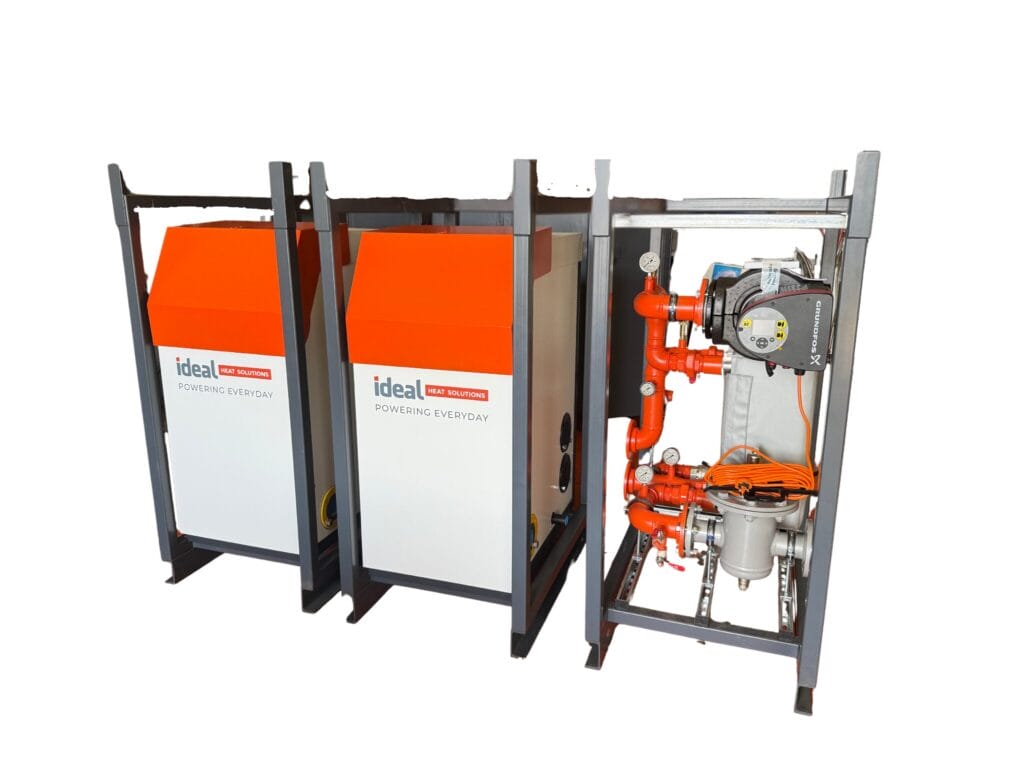
What Is a Modular Heating System?
A modular heating system uses several smaller condensing boilers connected together to operate as one coordinated heating plant.
Each individual boiler module functions independently while communicating through a central cascade controller that monitors building demand in real time.
Instead of a single large boiler cycling on and off regardless of the actual heating requirement, the modular system stages individual boilers on and off gradually depending on demand.
This allows the system to match output far more accurately to the building’s real operational load.
For example, during lower overnight demand, only one module may operate. As occupancy increases and the heating requirement rises, additional modules automatically activate to share the load. When demand falls again, boilers stage back down incrementally.
This approach creates much more stable and efficient operation.
Why Traditional Large Boilers Often Waste Energy
One of the biggest problems with traditional commercial boiler systems is oversizing.
Many buildings were originally designed with oversized plant to ensure heating capacity during peak winter conditions. While this may provide security, it often creates inefficiencies during normal operation because buildings spend very little time operating at maximum load.
In reality, most commercial heating systems operate at partial load for the majority of the year.
Large boilers running at low demand conditions often:
- cycle excessively
- operate outside optimal condensing conditions
- waste fuel
- suffer greater wear and tear
- struggle with temperature stability
This inefficiency becomes increasingly expensive as energy prices rise.
Modular systems solve this problem by distributing the load more intelligently across multiple smaller boilers operating at their most efficient range.
Why Part-Load Efficiency Is So Important
Part-load efficiency is one of the most important concepts in modern commercial heating.
Heating systems are rarely operating at 100% output continuously. External temperatures fluctuate, occupancy changes throughout the day, and domestic hot water demand rises and falls constantly.
Traditional boiler systems are often least efficient during these lower-load periods.
Modular cascade systems are specifically designed to improve performance under these real-world operating conditions.
Because multiple boilers share the load, the system can:
- maintain stable operating temperatures
- reduce unnecessary cycling
- improve condensing performance
- lower fuel consumption
- reduce operational strain on components
This becomes particularly valuable in larger commercial buildings where heating demand changes continuously throughout the day.
For facilities managers, the result is not only improved energy efficiency but also improved reliability and reduced long-term maintenance costs.
Why Modular Systems Improve Reliability
Another major advantage of modular heating systems is operational resilience.
With traditional single-boiler plant, a major boiler fault can compromise the entire heating system. In critical buildings, this creates significant operational risk.
Hospitals, hotels, care homes, universities, and residential developments often cannot tolerate complete heating or hot water loss.
Modular systems reduce this risk significantly because multiple boilers operate together in cascade.
If one module requires servicing or develops a fault:
- the remaining boilers continue operating
- heating capacity is reduced rather than completely lost
- maintenance can often be completed without major shutdowns
This built-in redundancy is one of the biggest reasons modular systems are widely used in mission-critical buildings.
Why Modular Boilers Are Easier to Maintain
Maintenance access is another important consideration.
Large commercial boilers can be difficult to service, particularly in older plant rooms with limited clearance space. Servicing often requires complete shutdowns, and access to internal components can be challenging.
Modular systems simplify this process considerably.
Because the boilers are smaller:
- servicing is easier
- access is improved
- individual modules can be isolated
- maintenance can often occur while the system remains operational
Modern modular systems also feature advanced diagnostics and smart controls that help engineers identify issues quickly before they become major failures.
For facilities teams managing busy commercial buildings, this reduction in maintenance disruption is extremely valuable.
Why Modular Systems Are Ideal for Restricted Access Buildings
Commercial plant rooms are becoming increasingly difficult to work within.
Modern buildings often prioritise usable floor space, leaving mechanical rooms smaller, more congested, and harder to access.
Many older buildings also feature:
- basement plant rooms
- narrow service corridors
- rooftop mechanical spaces
- limited service lifts
- confined access routes
Traditional large packaged boilers can be extremely difficult to install in these environments.
Modular systems solve this issue because the individual boiler modules are compact enough to fit through standard access routes before being assembled into a complete cascade system on site.
This flexibility makes modular heating systems ideal for:
- plant room refurbishments
- rooftop installations
- restricted-access buildings
- temporary heating projects
- occupied commercial environments
Modular Heating and Decarbonisation
As organisations work towards lower-carbon heating strategies, modular systems are becoming increasingly attractive because they integrate effectively with modern energy infrastructure.
Many modular condensing systems already provide:
- ultra-low NOx emissions
- excellent condensing performance
- advanced load optimisation
- compatibility with modern BMS controls
They also integrate well with:
- heat pumps
- hybrid heating systems
- low-temperature circuits
- renewable technologies
For many commercial buildings, modular systems form an important stepping stone within wider decarbonisation strategies.
Why Modular Boiler Hire Is Growing
The advantages of modular systems have also driven significant growth in modular boiler hire across the UK.
Temporary heating projects increasingly require:
- rapid deployment
- restricted-access flexibility
- scalable outputs
- operational redundancy
- high energy efficiency
Modular temporary boiler systems provide all of these benefits.
They are now widely used during:
- emergency boiler breakdowns
- plant room replacement projects
- phased refurbishments
- decarbonisation works
- seasonal demand periods
For many sites, modular systems are now considered a far more flexible alternative to traditional temporary packaged boilers.
The Future of Commercial Heating
Commercial heating systems are moving toward smarter, more adaptable infrastructure.
Buildings now demand:
- higher efficiency
- better resilience
- improved flexibility
- lower emissions
- easier maintenance
- scalable operation
Modular heating systems address all of these requirements simultaneously.
Rather than designing heating around oversized fixed-output plant, modular systems allow buildings to operate more dynamically, more efficiently, and with far greater operational security.
As energy costs continue rising and sustainability standards tighten further, modular systems are likely to become even more common across both permanent and temporary commercial heating applications.
Conclusion
Modular heating systems represent one of the most significant developments in modern commercial boiler design.
By using multiple boilers operating together intelligently in cascade, these systems deliver improved efficiency, better resilience, easier maintenance, and greater operational flexibility compared to many traditional single-boiler installations.
Whether used for permanent infrastructure or temporary boiler hire projects, modular systems provide a smarter and more adaptable approach to commercial heating.
Ideal Heat Solutions supplies modular boiler hire solutions across the UK for commercial and industrial applications requiring scalable, high-efficiency temporary heating systems.
Contact our team today to discuss your project requirements or arrange a technical survey.
FAQs
What is a modular heating system?
A modular heating system uses multiple smaller boilers connected together in cascade to provide scalable commercial heating.
Why are modular systems more efficient?
They improve part-load efficiency by matching heating output more closely to real-time building demand.
What is a cascade boiler system?
A cascade system links multiple boilers together under intelligent controls so they operate as one coordinated heating plant.
Do modular systems improve reliability?
Yes. Multiple boilers provide built-in redundancy, allowing heating to continue even if one module requires maintenance.
Are modular systems suitable for temporary heating?
Yes. Modular boiler systems are widely used for temporary heating projects because they are scalable, efficient, and suitable for restricted-access environments.
What buildings commonly use modular heating systems?
Hospitals, hotels, schools, universities, offices, residential developments, and industrial facilities commonly use modular systems.