

Selecting the correct chiller capacity is one of the most important decisions in any temporary cooling installation. Get it right, and the hire unit will provide reliable, efficient cooling throughout its deployment. Get it wrong, undersizing the unit, and you will struggle to meet your cooling demand; oversizing and the unit will cycle inefficiently, wasting energy and potentially causing temperature instability.
This guide explains how chiller capacity is measured, how cooling loads are calculated for different building types and applications, and how to match chiller capacity to your specific temporary installation requirements.

Understanding Chiller Capacity: kW and Tonnes
Chiller capacity is measured in kilowatts (kW) in the UK, reflecting the rate at which the unit can remove heat from the chilled water circuit. You may also encounter capacity expressed in tonnes of refrigeration (TR) in older documentation; one tonne of refrigeration is approximately 3.5kW.
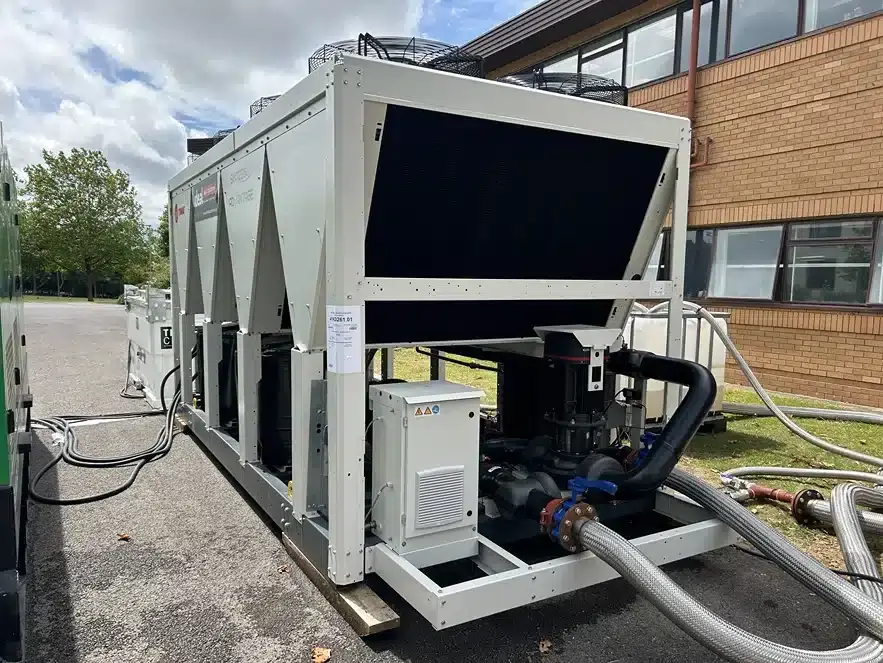
Ideal Heat Solutions’ hire fleet ranges from 50kW (heat pump chillers) up to 850kW (cooling-only chillers). The right capacity for your application will depend on the total heat gain that needs to be removed, the chilled water flow rate and temperature differential your system operates at, and whether the temporary chiller needs to replace the full capacity of the failed or isolated permanent plant, or only part of it.
Calculating Cooling Load for Commercial Buildings
For commercial buildings, the cooling load is determined by a combination of factors:
- Solar gain: Heat entering the building through windows and the building fabric, driven by sunlight and external temperature
- Occupancy load: Heat generated by building occupants (typically 75–100W per person for office environments)
- Equipment load: Heat generated by computers, servers, lighting, and other electrical equipment
- Ventilation load: Heat introduced by fresh air ventilation
- Infiltration: Heat entering through gaps in the building fabric
For a standard UK office building, a rough rule of thumb is approximately 50–80W per square metre of floor area for cooling load, including solar and occupancy gains. A 1,000 sq m office building might therefore require between 50kW and 80kW of cooling capacity.
This is a starting point only; actual loads vary significantly depending on building orientation, glazing ratio, occupancy density, and equipment loads. For a temporary installation, it is worth applying a margin of 10–20% above the calculated load to account for uncertainty and peak demand conditions.
Calculating Cooling Load for Industrial and Process Applications
Industrial cooling load calculations are more straightforward in some respects; the primary heat source is typically the process itself, and the heat input is often specified by the equipment manufacturer. For example, an injection moulding machine may specify a cooling water heat load of 30kW at full production rate.
Where multiple machines or processes need to be cooled simultaneously, the total load is the sum of the individual process loads. Add a 15–20% margin for ambient heat gain, piping losses, and peak demand conditions to arrive at a design cooling load.
One important consideration in process cooling is the required chilled water temperature. Some industrial processes require very cold water, below 10°C or even below 5°C, which affects chiller selection. Standard commercial chillers typically produce chilled water at 6–12°C; for lower temperatures, specialist low-temperature chillers may be required.
Matching Chiller Capacity to the Failed Plant
In emergencies, where a hire chiller is being used to replace a failed permanent plant, the simplest approach is to match the hire unit’s capacity to the nameplate capacity of the failed chiller. If the permanent chiller is rated at 400kW, hire an IHS 400 Chiller; if it is 500kW, hire an IHS 500 Chiller.
However, this assumes that the permanent chiller was correctly sized for the building’s current load, which is not always the case. Buildings are sometimes over-cooled in winter and under-cooled in summer, or the building has been extended or its occupancy has increased since the permanent plant was installed. Where time permits, it is worth assessing whether the building’s actual cooling demand matches the permanent chiller’s nameplate capacity.
The Importance of Chilled Water Flow Rate
Chiller capacity alone does not guarantee a successful temporary installation. The chiller must also be able to deliver chilled water at an adequate flow rate to meet the system’s demand. Most commercial chillers operate on a 6/12°C chilled water temperature differential, meaning chilled water leaves the chiller at 6°C and returns at 12°C, having absorbed heat from the building.
The required flow rate (in litres per second) is calculated as the cooling load (in kW) divided by 4.2 (the specific heat of water) divided by the temperature differential (6°C). A 400kW chiller on a 6°C differential requires a flow rate of approximately 15.9 litres per second.
Ensuring that the existing building pipework and pump set can deliver this flow rate to the hire chiller is an essential part of the pre-installation assessment. If the existing pumps are undersized, additional temporary pumping capacity may be required.
Seeking Expert Guidance
For most temporary chiller hire applications, the most reliable approach is to engage a specialist hire provider, such as Ideal Heat Solutions, to carry out a site survey and recommend the appropriate equipment. Our engineers are experienced in cooling load assessment across a wide range of building types and industrial applications, and will ensure that the equipment specified is appropriate for your specific situation.
To find out more or to arrange a free site survey, call Ideal Heat Solutions on 01622 632 918