

Temporary boiler installations are rarely straightforward. In many commercial and industrial buildings, simply getting equipment into position is one of the biggest challenges of the entire project.
Hospitals, universities, hotels, high-rise buildings, leisure centres, and older commercial properties often contain plant rooms located in basements, rooftops, internal service corridors, or highly confined mechanical spaces. These environments were never designed for modern packaged boiler plant, particularly when large temporary systems are required during breakdowns, refurbishment works, or planned replacement projects.
Traditional temporary boiler solutions can quickly become impractical in these situations. Large packaged boilers may require cranes, road closures, temporary structural works, or even partial building dismantling simply to position the equipment.
This is why modular boiler hire has become one of the fastest-growing solutions for restricted-access heating projects across the UK.
At Ideal Heat Solutions, we regularly support commercial and industrial clients with modular temporary boiler systems specifically designed for challenging plant room environments where conventional boiler installations are simply not feasible.
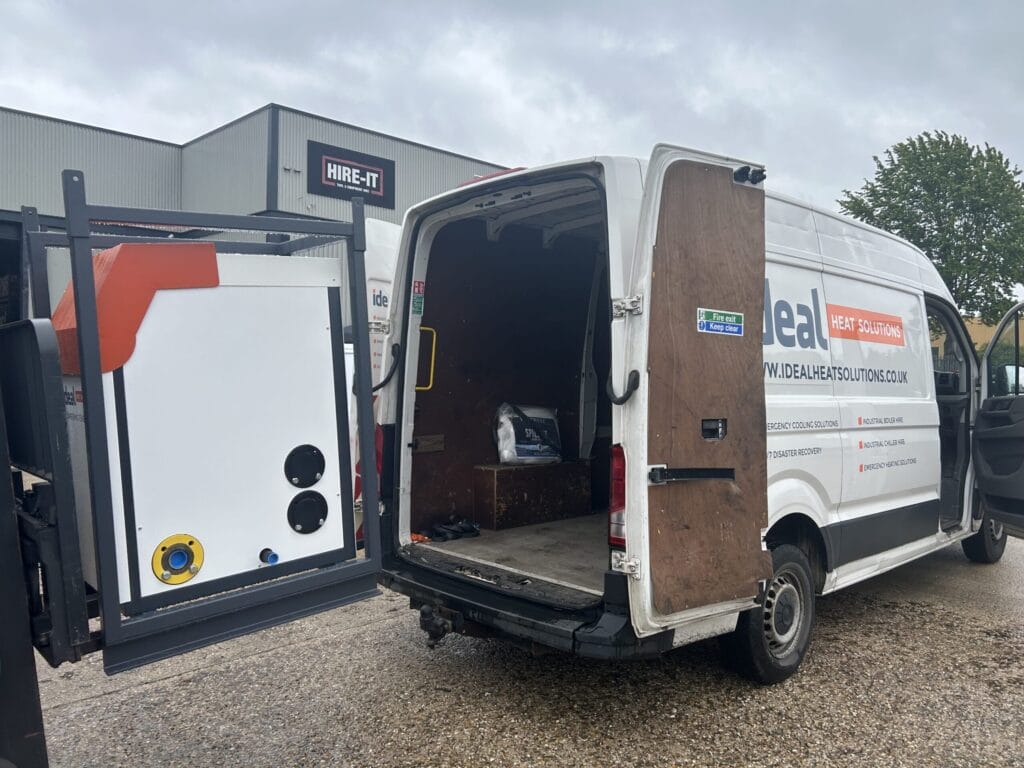
Why Restricted Access Creates Major Problems for Temporary Boiler Projects
Restricted-access buildings create both logistical and operational difficulties during temporary heating installations.
In many cases, the issue is not boiler capacity. It is physical access.
Facilities managers and contractors often face challenges such as:
- Narrow service corridors
- Tight doorways
- Limited ceiling heights
- Basement plant rooms
- Rooftop mechanical areas
- Weight restrictions
- Occupied buildings
- Lack of crane access
- Congested city-centre locations
In healthcare and education environments, disruption must also be minimised because buildings often remain operational throughout the project.
The larger the temporary boiler system, the more difficult installation becomes.
Traditional packaged boiler plant can create several issues:
- High crane hire costs
- Complex lift planning
- Temporary road closures
- Long installation times
- Structural assessments
- Extended project disruption
- Increased health and safety risk
For emergency heating failures, these delays can be extremely costly.
Why Modular Boiler Systems Solve the Access Problem
Modular boiler systems completely change the installation approach.
Instead of relying on one large temporary boiler unit, modular systems use multiple compact condensing boiler modules connected together in cascade.
Each individual module is small enough to pass through standard commercial access routes, including:
- Doorways
- Service corridors
- Goods lifts
- Basement access routes
- Rooftop walkways
Once inside the plant area, the modules are connected together to create a scalable temporary heating plant precisely matched to the building’s requirements.
This dramatically simplifies installation logistics.
The IHS Modular Boiler uses 160kW modules capable of delivering total cascade outputs up to 3,000kW while maintaining a highly compact footprint.
For buildings with restricted access, this flexibility can make the difference between a practical temporary heating solution and a project that becomes operationally unmanageable.
Reduced Disruption for Occupied Buildings
One of the biggest advantages of modular temporary boiler systems is the reduction in disruption.
Many commercial and public-sector buildings cannot tolerate lengthy shutdowns or invasive installation works.
Examples include:
- Hospitals requiring continuous hot water
- Hotels operating at full occupancy
- Universities during term time
- Care homes supporting vulnerable residents
- Commercial offices maintaining tenant operations
- Leisure centres keeping pools and showers operational
Modular boiler systems minimise disruption because:
- Large crane lifts may be avoided entirely
- Installation can be phased
- Smaller equipment is easier to manoeuvre safely
- Existing systems can remain partially operational
- Internal disruption is reduced
- External compounds can remain smaller
This allows projects to progress faster while maintaining business continuity.
Why Plant Room Space Matters
Plant room space is becoming increasingly constrained in modern buildings.
Over the last two decades, commercial developments have prioritised usable floor space, often reducing the size of mechanical areas significantly.
As a result, many plant rooms now suffer from:
- Minimal service clearances
- Congested pipework
- Limited access routes
- Poor equipment separation
- Restricted maintenance space
This becomes particularly problematic during boiler replacement projects.
Traditional temporary packaged boilers may simply not fit into the available footprint.
Modular boilers are specifically designed to address this issue.
Their compact dimensions allow systems to be configured around existing infrastructure while still delivering high heating outputs.
For many facilities managers, this flexibility removes the need for costly structural modifications or temporary external plant compounds.
Scalable Heating Capacity for Complex Buildings
Another major advantage of modular boiler systems is scalability.
Unlike fixed-output packaged boilers, modular systems allow capacity to be expanded incrementally depending on building demand.
This is especially useful for:
- Phased refurbishment projects
- Seasonal demand variation
- Multi-stage construction works
- Temporary decarbonisation upgrades
- Partial building occupation
For example:
- A smaller initial heating load may require two modules
- Additional modules can be added later
- Systems can be reconfigured as demand changes
- Redundancy can be increased for critical buildings
This creates a highly flexible temporary heating strategy that adapts to the project rather than forcing the project to adapt to the boiler plant.
Efficiency Benefits of Modular Heating Systems
Modern modular condensing boilers are also highly efficient.
The IHS Modular Boiler range delivers:
- Net efficiencies exceeding 105%
- Ultra-low NOx Class 6 emissions
- Advanced cascade sequencing
- Intelligent load matching
- Full BMS compatibility
- Low-temperature condensing performance
Traditional single large boilers often operate inefficiently at partial load.
Modular systems avoid this problem by staging boilers on and off depending on actual heating demand.
This improves:
- Fuel efficiency
- Temperature stability
- Equipment lifespan
- Carbon performance
- Operational cost control
For organisations facing rising energy prices and increasing sustainability pressure, these efficiencies are highly valuable.
Redundancy and Reliability for Critical Sites
Restricted-access buildings are often mission-critical environments.
In hospitals, hotels, universities, and care facilities, heating failures can have severe operational consequences.
One of the major benefits of modular boiler systems is built-in redundancy.
Because multiple boiler modules operate together:
- Heating can continue if one module requires servicing
- Planned maintenance becomes easier
- Operational resilience improves
- Downtime risk is reduced
This is particularly important for:
- Healthcare environments
- Residential developments
- Public-sector facilities
- Manufacturing sites
- Hotels and hospitality venues
For many clients, redundancy is just as important as heating output itself.
Restricted-Access Boiler Hire for Decarbonisation Projects
Many temporary boiler projects are now linked to wider decarbonisation and refurbishment programmes.
Buildings undergoing energy upgrades often require temporary heating while:
- Existing boilers are removed
- Pipework is upgraded
- BMS systems are replaced
- Heat pumps are integrated
- Low-carbon infrastructure is installed
Modular temporary boiler systems provide the flexibility needed to support these projects without disrupting building operation.
Their scalability also makes them ideal for hybrid heating strategies where temporary systems support phased low-carbon transitions.
Common Applications for Restricted-Access Modular Boiler Hire
Ideal Heat Solutions regularly supplies modular temporary boiler systems for:
- Hospitals
- Healthcare facilities
- Universities
- Schools
- Hotels
- Leisure centres
- High-rise residential buildings
- Commercial office blocks
- Historic buildings
- Industrial facilities
Each project presents different access challenges, which is why careful site surveys and technical planning are essential.
Why Specialist Support Matters
Restricted-access temporary boiler projects require more than equipment alone.
Successful installations depend on:
- Detailed site assessment
- Access route planning
- Hydraulic integration
- Load calculations
- Ancillary specification
- Safety compliance
- Lift planning
- Operational sequencing
At Ideal Heat Solutions, we provide complete project support including:
- Technical surveys
- Boiler specification
- Pumps and plate heat exchangers
- Buffer vessels
- Fuel systems
- Pipework and hoses
- Trend BMS integration
- Delivery and installation
- Commissioning and support
This ensures the temporary heating system operates safely, efficiently, and reliably throughout the hire period.
Conclusion
Restricted-access buildings require specialist temporary heating solutions capable of overcoming complex logistical and operational challenges.
Modular boiler hire provides the manoeuvrability, scalability, efficiency, and resilience needed to deliver reliable heating without major disruption.
Whether supporting emergency breakdowns, plant room refurbishments, rooftop installations, or phased decarbonisation projects, modular boiler systems offer a smarter and more flexible alternative to traditional packaged temporary boilers.
Ideal Heat Solutions supports commercial and industrial clients across the UK with scalable modular boiler hire systems designed specifically for challenging access environments.
Contact our team today to arrange a technical survey or discuss your temporary heating requirements.
Need a Temporary HVAC Solution?
From temporary boiler and chiller hire to portable cooling, heaters, generators and fuel tanks, Ideal Heat Solutions provides reliable temporary HVAC solutions for commercial, industrial and public sector organisations across the UK.
Whether you’re responding to an emergency, planning maintenance works or preparing a contingency plan, our experienced team can help identify the right solution for your project.
Contact us today to discuss your requirements, arrange a site survey or request a no-obligation quotation.
📞 0808 231 3886
🌐 www.idealheatsolutions.co.uk/contact-us/
FAQs
What is restricted-access boiler hire?
Restricted-access boiler hire refers to temporary boiler systems designed for buildings where plant rooms are difficult to access due to confined spaces, narrow corridors, basements, rooftops, or limited crane access.
Why are modular boilers suitable for restricted-access projects?
Modular boilers use compact individual units that can pass through standard doorways, service corridors, and lifts before being connected together on-site.
Can modular boilers fit into existing plant rooms?
Yes. Modular systems are specifically designed for confined plant room environments where large packaged boilers may not fit.
What industries commonly use restricted-access boiler systems?
Healthcare, education, hospitality, commercial property, residential developments, and industrial facilities commonly require restricted-access temporary heating solutions.
Do modular boiler systems provide redundancy?
Yes. Multiple modules operate together, allowing heating to continue even if one module requires servicing or maintenance.
Are modular boilers energy efficient?
Yes. Modern modular condensing boilers deliver high efficiencies, low NOx emissions, and advanced load matching for improved fuel performance.